We propose a hydrodynamic theory to examine the emergence of contraction
waves in dense active liquids composed of pulsating deformable particles.
Our theory couples the liquid density with a chemical phase that
determines the periodic deformation of the particles. This
mechanochemical coupling regulates the interplay between the flow induced
by local deformation and the resistance to pulsation stemming from steric
interactions. We show that this interplay leads the emergent contraction
waves to spontaneously organize into a packing of pacemakers. We reveal
that the dynamics of these pacemakers is governed by a complex feedback
between slow and fast topological defects that form asters in velocity
flows. Our defect analysis provides a versatile framework for
investigating the self-organization of waves in a wide range of
contractile systems. These results shed light on key mechanisms that
control the rich phenomenology of pulsating liquids, with relevance to
biological systems such as tissues composed of confluent pulsating cells.
TB, T. Desaleux, J. Ranft and E. Fodor,
arXiv:2509.19024 (2025)
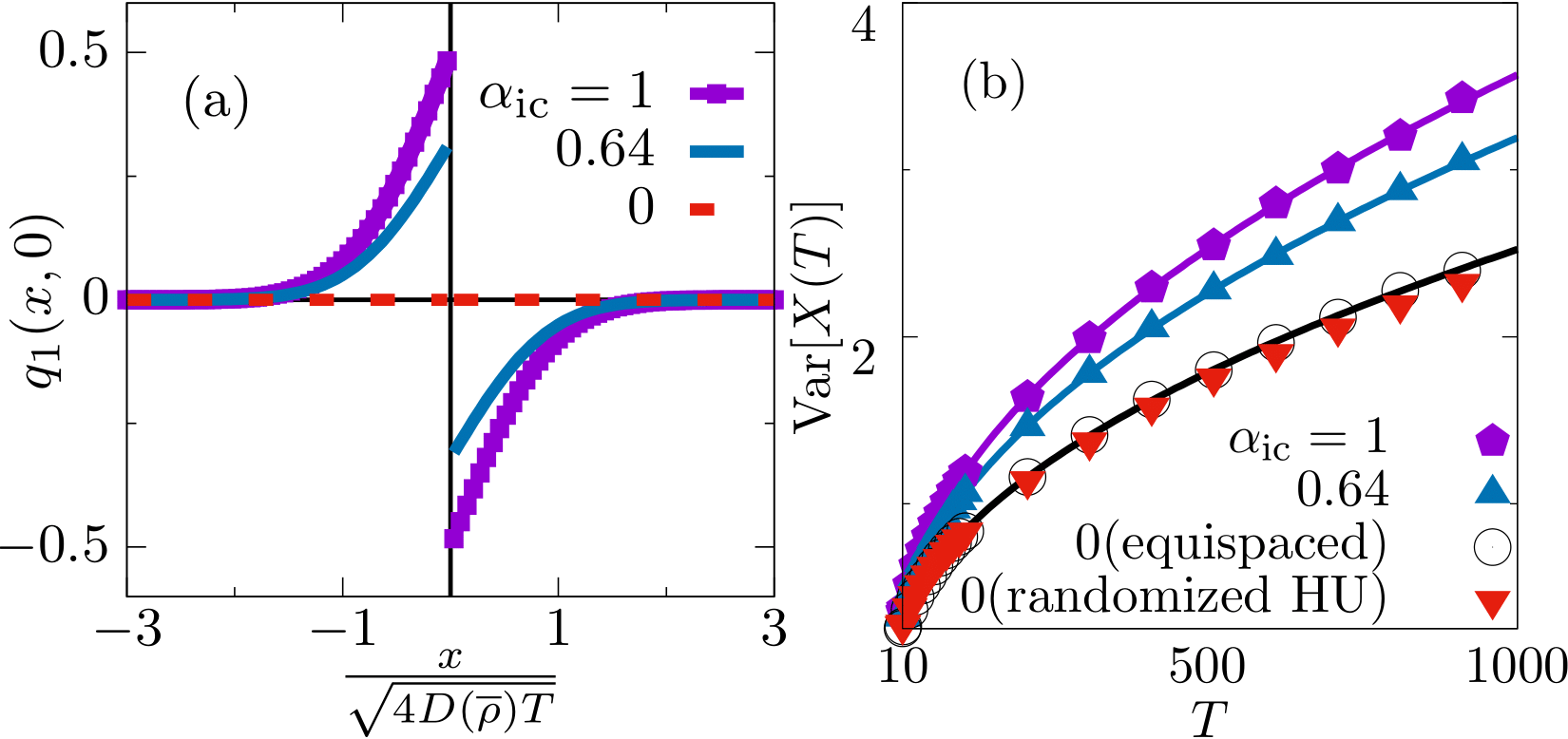
We analyze the long-lasting effects of initial conditions on dynamical
fluctuations in one-dimensional diffusive systems. We consider the
mean-squared displacement of tracers in homogeneous systems with
single-file diffusion and current fluctuations for noninteracting
diffusive particles. In each case, we show analytically that the
long-term memory of initial conditions is mediated by a single static
quantity: a generalized compressibility that quantifies the density
fluctuations of the initial state. We thereby identify a universality
class of hyperuniform initial states whose dynamical variances coincide
with previously studied quenched cases, alongside a continuous family of
other classes among which equilibrated (annealed) initial conditions are
but one member. Extensive Monte Carlo simulations verify these
predictions.
 TB, R. L. Jack and M. E. Cates,
Phys. Rev. E 106, L062101 (2022)
TB, R. L. Jack and M. E. Cates,
Phys. Rev. E 106, L062101 (2022)
We are currently developing a general framework for the optimal control of
fluctuating mesoscopic systems governed by field-theoretic dynamics with arbitrary
free-energy functionals, mobilities, and multiple control parameters.
Focusing on the near-quasi-static, small-noise regime, we derive explicit
expressions for the work performed during slow driving protocols by
expanding around equilibrium solutions. Our approach applies broadly to
systems such as Model A magnetization dynamics and phase-separating
fields, allowing systematic evaluation of the energetic cost associated
with finite-time control. By minimizing the leading-order correction to
quasi-static work, we identify optimal protocols for varying control
parameters and clarify conditions for the uniqueness of optimal paths.
This framework provides a basis for designing energetically efficient
protocols in complex, multi-parameter, macroscopically fluctuating
systems.
J. Miranda, TB, T. Agranov and E. Fodor, in prep. (2026)